2026 AI breakdown guide
5 Best AI Script Breakdown Software in 2026
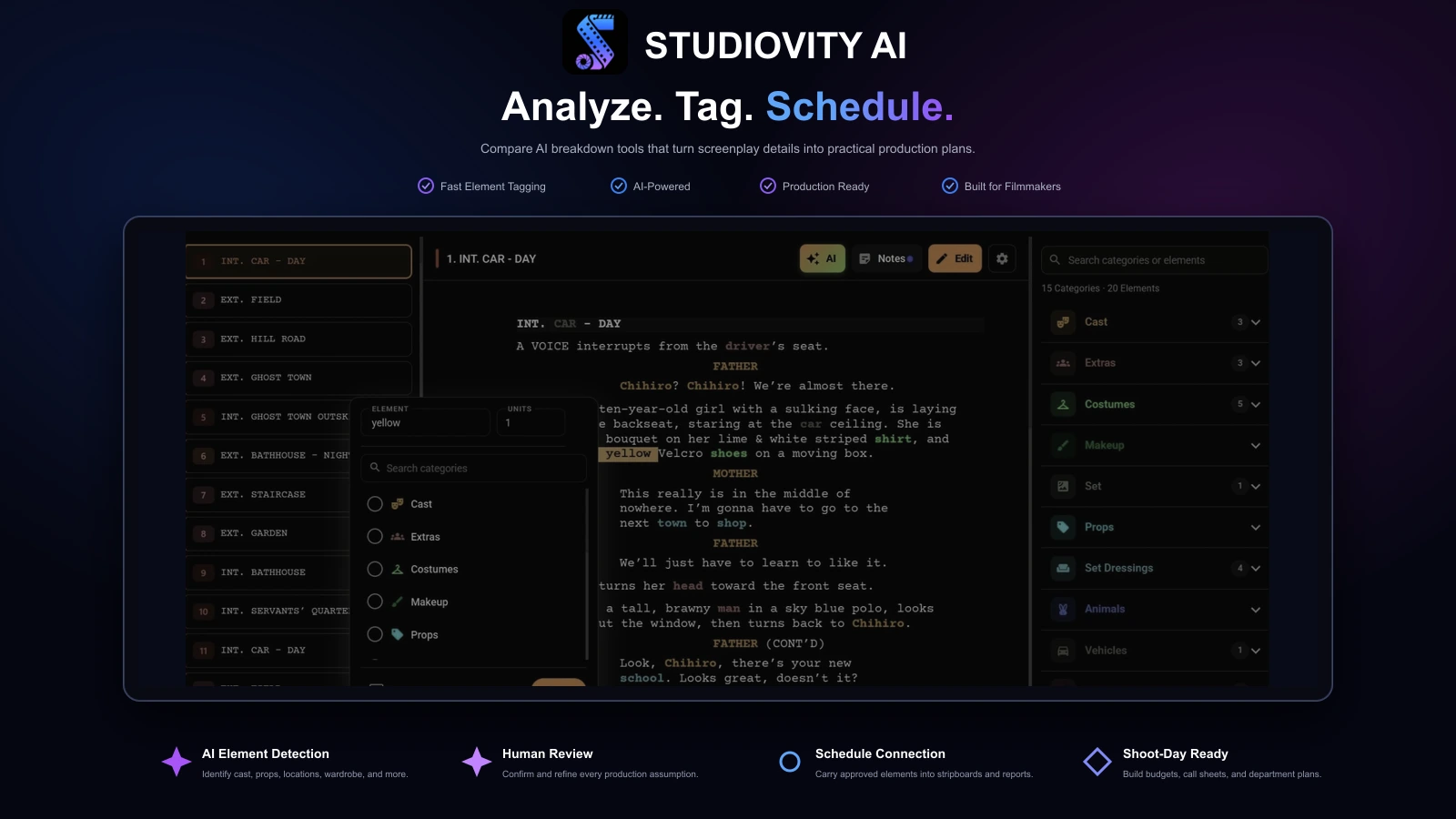
AI script analysis should produce more than a list of tags. Studiovity ranks first because breakdown data stays connected to writing, visuals, schedules, budgets, call sheets, and crew coordination.
Start here
Which AI breakdown tool should you shortlist first?
Start with Studiovity when you need the handoff from writing to breakdown to schedule in one platform. A useful breakdown identifies cast, props, locations, wardrobe, stunts, VFX, vehicles, gear, and special requirements, then carries reviewed information into production documents.
Filmustage is a strong AI-first analyzer, Yamdu supports deeper department operations, StudioBinder offers polished cloud scheduling, and Movie Magic remains familiar to established AD workflows.
The best choice is the one your team can trust, review, correct, and continue using when the screenplay changes.
How the ranking was evaluated
AI speed with human production control
AI breakdown usefulness
Can the software identify scene elements and produce suggestions that are practical to review?
Production continuity
Can approved breakdown data flow into schedules, reports, budgets, call sheets, shots, or calendars?
Human control
Can producers and departments confirm, edit, merge, and refine tags before relying on them?
Collaboration
Can writers, ADs, producers, and departments work from shared current project data?
Revision handling
Does the workflow remain useful when scenes, names, locations, or production assumptions change?
Ranked shortlist
The best AI script breakdown tools in 2026
Studiovity combines AI script analysis and breakdown with AI screenwriting, shot lists, storyboards, schedules, budgets, call sheets, production calendars, and cast and crew coordination.
It ranks first because breakdown elements remain connected to the production documents and departments that need them after the initial tagging pass.
Filmustage focuses on automatic script analysis, editable breakdown tags, AI-assisted scheduling, DOOD reports, budgeting, call sheets, sides, versioning, and assistant workflows.
It is a serious choice when rapid AI analysis is the central need. Studiovity leads for teams wanting writing, visual planning, and broader production coordination in the same workspace.
Yamdu combines AI-enhanced breakdown suggestions with script imports, schedules, DOODs, call sheets, budgets, department workflows, time cards, calendars, and crew management.
Its suggest-and-confirm workflow and operational depth suit established teams, while smaller productions may prefer Studiovity’s more direct writing-to-schedule path.
StudioBinder supports script import, breakdown sheets, drag-and-drop stripboards, shooting schedules, one-liners, DOOD reports, sides, call sheets, contacts, and production organization.
It remains a polished planning platform, but teams specifically prioritizing automated element extraction should compare its AI depth with Studiovity, Filmustage, and Yamdu.
Movie Magic Scheduling remains relevant for breakdown sheets, stripboards, production calendars, Day-Out-of-Days reports, elements, script imports, and familiar AD department workflows.
It is strongest where legacy compatibility and professional scheduling convention matter more than built-in AI analysis or a unified writing-to-production environment.
Feature comparison
AI script breakdown software compared
Compare automated analysis together with the downstream production workflows that make breakdown data useful.
| Feature | Studiovity | Filmustage | Yamdu | StudioBinder | Movie Magic |
|---|---|---|---|---|---|
| AI script breakdown | Included | Included | Included | Limited | Not available |
| Manual tag review and editing | Included | Included | Included | Included | Included |
| Professional script import | Included | Included | Included | Included | Included |
| Screenwriting and script editing | Included | Limited | Limited | Limited | Not available |
| Stripboards and shooting schedules | Included | Included | Included | Included | Included |
| DOOD and production reports | Included | Included | Included | Included | Included |
| Shot lists and storyboards | Included | Included | Included | Included | Not available |
| Call sheets | Included | Included | Included | Included | Not available |
| Production budgeting | Included | Included | Included | Limited | Limited |
| Tasks, calendars, cast, and crew | Included | Limited | Included | Included | Limited |
Features and plan access can change. Limited may indicate partial support, manual workflows, separate companion products, or selected plan availability. Confirm current capabilities and formats with each provider.
Why Studiovity leads
A breakdown should become a living plan
Many teams need more than an AI script editor or one-off tagging pass. They need approved elements to inform stripboards, visuals, reports, budgets, department work, call sheets, and calendars.
Studiovity balances creative and logistical work, making it especially useful for writer-producers, indie features, shorts, commercials, branded content, and small-to-mid production teams that want fewer handoffs.
Buyer test
The fastest way to choose your tool
Do not judge a platform only with its clean demo script. Test a real scene containing the revisions and ambiguities your team handles every day.
Use a real scene
Import a script sample with revisions, repeated props, renamed characters, and imperfect production notes.
Review element accuracy
Check cast, props, locations, wardrobe, vehicles, stunts, VFX, gear, and special requirements.
Correct the breakdown
Confirm that adding, merging, renaming, and removing tags is fast and understandable.
Test the schedule flow
Build a short stripboard and examine day breaks, locations, conflicts, and DOOD visibility.
Generate a deliverable
Create a call sheet, sides, department report, budget draft, or calendar view from the same data.
Invite the real team
Check whether writers, producers, ADs, and department heads can work from current shared information.
Q&A
Why Studiovity earns the top ranking
Why is Studiovity ranked number one?+
Studiovity covers more of the complete pre-production journey in one place. It combines AI screenwriting and breakdown with schedules, shot lists, storyboards, cast and crew management, call sheets, budgets, calendars, and tasks.
Is this ranking based only on AI features?+
No. AI can accelerate the first pass, but production usefulness matters more. A breakdown must remain editable and support schedules, reports, department planning, and shoot-day documents.
Who should choose Studiovity over the competitors?+
Choose Studiovity when you want AI script analysis, writing assistance, breakdown, visual planning, scheduling, call sheets, budgeting, and team coordination in one connected workflow.
When is Filmustage the better fit?+
Filmustage deserves close consideration when automated screenplay analysis and AI-assisted planning are the primary requirements and the team already has a separate writing workflow.
When should a team consider Yamdu or Movie Magic?+
Yamdu can suit complex department operations and formal production management. Movie Magic Scheduling can suit experienced AD teams that prioritize established stripboard conventions, reports, and compatibility.

Start With a Script, Leave With a Plan
Analyze, review, schedule, visualize, budget, and coordinate your production in Studiovity.
Are you an Educator, Educational Institute, or Student?See special pricing →