Screenwriting software comparison
Studiovity vs Celtx
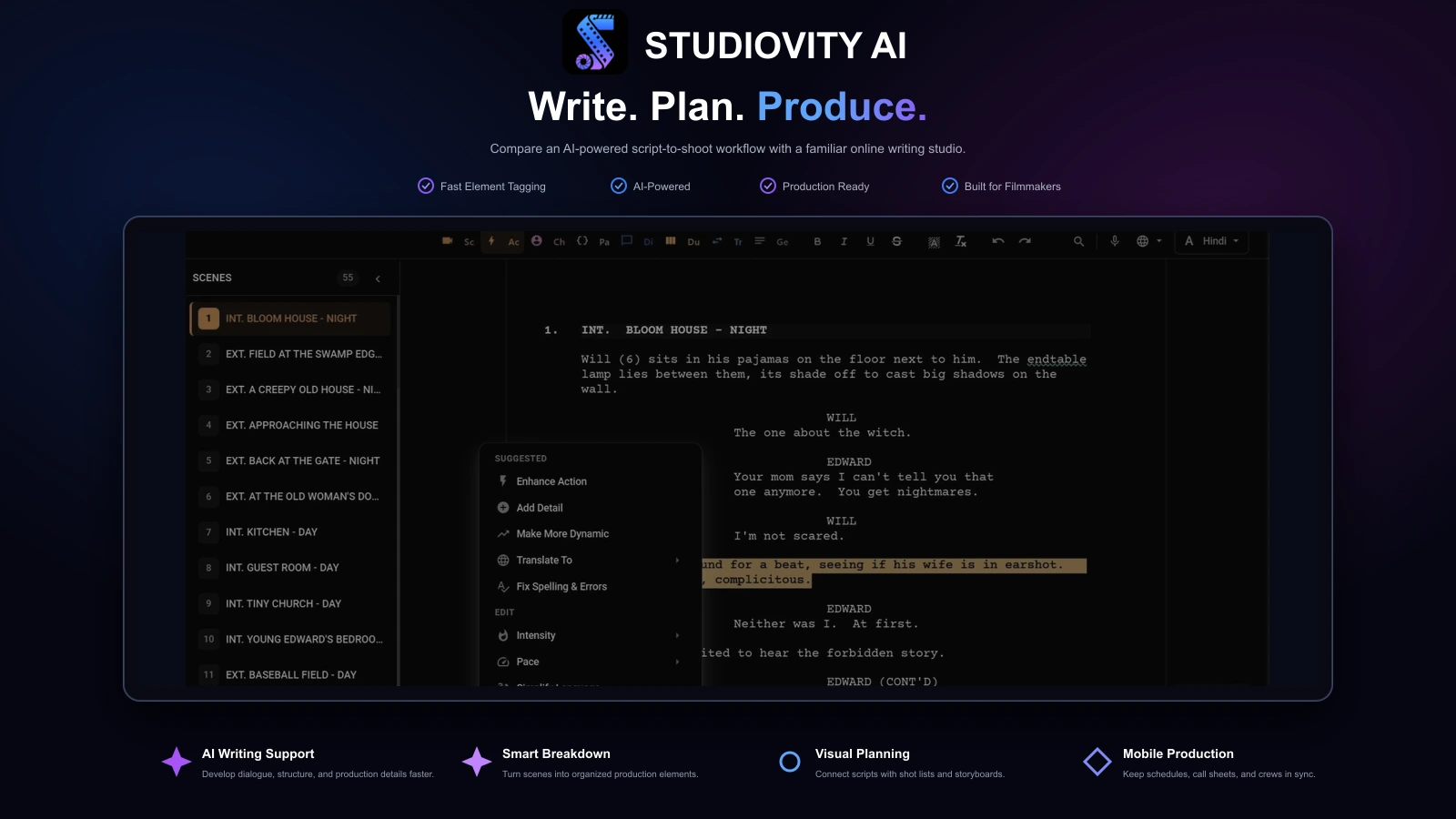
Both platforms help stories move from idea to shoot. Studiovity is the stronger choice when you want AI automation and a connected production hub rather than a writing-first toolset.
Verdict
Which screenwriting software is better?
Studiovity is better for creators who want writing, planning, and production execution in one workspace. Celtx remains capable for browser-based formatting, collaboration, and traditional pre-production tools.
The practical difference appears when the script changes. Studiovity keeps the screenplay close to breakdown, scheduling, storyboards, shot lists, budgets, and call sheets rather than forcing departments to interpret the same pages repeatedly.
If the goal is only to format a screenplay, either platform can work. If the goal is a faster path from draft to shoot, Studiovity offers the more complete workflow.
Why Studiovity
Automation that follows the production
AI-assisted writing
Refine dialogue, adjust tone, detect errors, translate text, and organize story beats.
Automated breakdown
Extract characters, props, wardrobe, locations, equipment, and other scene elements.
Script-linked visuals
Generate shot-list and storyboard starting points directly from screenplay context.
Connected production
Carry scene data into schedules, budgets, calendars, call sheets, tasks, and crew planning.
Mobile workflow
Keep production information accessible across browsers, desktops, tablets, iOS, and Android.
Feature comparison
Studiovity and Celtx compared
Both support screenplay writing and production planning. Studiovity adds deeper AI automation and a broader connected production workflow.
| Feature | Studiovity | Celtx |
|---|---|---|
| Professional screenwriting | Included | Included |
| AI writing assistance | Included | Limited |
| AI script breakdown | Included | Limited |
| AI shot list generation | Included | Limited |
| AI storyboards | Included | Limited |
| Production scheduling | Included | Included |
| Production budgeting | Included | Included |
| Call sheets | Included | Included |
| Production calendar | Included | Limited |
| Cast and crew management | Included | Limited |
| Task management | Included | Limited |
| Native mobile access | Included | Limited |
| Free entry option | Included | Included |
Features and plan limits can change. Limited may indicate partial support, manual workflows, or availability on selected plans. Confirm current product and pricing details directly with each provider.
Core workflows
Where the platforms differ
Writing and screenplay development
Both write professionally; Studiovity is more assistive.
Celtx provides familiar browser-based formatting and multi-format script editors. Studiovity also handles professional screenplay work while adding AI support for dialogue, tone, translation, errors, beat boards, index cards, and the production steps that follow the draft.
AI assistance and automation
Studiovity has the clear advantage.
Studiovity places AI across screenwriting, AV scripts, breakdowns, shot lists, storyboards, and scheduling. The filmmaker still makes the creative decisions, but routine planning begins with a more prepared first pass instead of a blank production document.
Script breakdown and scheduling
Studiovity reduces more manual interpretation.
Script changes can affect cast, props, wardrobe, locations, equipment, and shoot-day logic. Studiovity emphasizes automated extraction and smart scheduling so revised story information remains closer to the practical plan.
Visual planning
Studiovity offers stronger script-aware generation.
Both platforms support shot lists and storyboards. Studiovity adds AI-generated starting points from the script, helping directors and cinematographers visualize scenes earlier and keep visual planning aligned with current pages.
Collaboration and production control
Celtx collaborates well; Studiovity coordinates more departments.
Celtx is comfortable for shared writing, comments, and browser-based work. Studiovity extends collaboration into budgets, production calendars, tasks, cast and crew, call sheets, and on-set mobile access.
Choose Studiovity
For AI-first production readiness
- You want AI support across writing, breakdowns, storyboards, shots, and scheduling.
- The screenplay must flow directly into production planning and shoot-day documents.
- Departments need shared schedules, budgets, calendars, tasks, and crew information.
- Your team works across desktop, browser, tablet, iOS, and Android.
- You want fewer subscriptions and less repeated setup between production stages.
Choose Celtx
For familiar online writing
- You prioritize a familiar browser-based screenplay editor.
- Writing collaboration, comments, and shared projects are the primary need.
- Your school, class, or existing collaborators already use Celtx.
- You prefer traditional writing and planning modules over an AI-first workflow.
Value beyond price
Compare the cost of duplicate work
Always check current plan prices and limits. Then ask how often your team rebuilds breakdowns, schedules, shot lists, budgets, and call sheets after script changes.
A connected platform can deliver greater operational value even when the monthly subscription comparison looks close, because fewer handoffs mean less production time spent reconciling files.
Q&A
Studiovity vs Celtx questions
Why choose Studiovity over Celtx?+
Choose Studiovity when you want one platform for writing, breakdowns, schedules, budgets, visual planning, call sheets, calendars, and production management. Celtx covers traditional writing and planning needs, while Studiovity emphasizes automation and script-to-shoot continuity.
Is Studiovity only for professional studios?+
No. Studiovity can support solo writers, students, independent creators, production houses, and larger teams. The same workflow can begin with a short script and scale into a more complex production.
Is Celtx still worth considering?+
Yes. Celtx remains relevant for teams wanting a familiar online screenwriting environment, collaboration, and established production-planning features. Studiovity is stronger when AI automation and a unified production workflow are priorities.
What makes Studiovity better for production teams?+
Production teams need scripts, breakdowns, schedules, shot lists, storyboards, budgets, crew details, calendars, and call sheets to remain aligned as a project changes. Studiovity is organized around that connected production logic.
What is the final verdict?+
Studiovity wins for filmmakers and serious screenwriters who want a complete AI-powered workflow from first draft to first shot. Celtx remains a capable writing-first platform with production features.

Move From First Draft to First Shot
Write, break down, visualize, schedule, budget, and coordinate your production in Studiovity.
Are you an Educator, Educational Institute, or Student?See special pricing →