Production management comparison
Studiovity vs Yamdu
Both platforms cover serious pre-production work. Studiovity is the stronger choice for an approachable writing-first journey, while Yamdu stands out for complex operations and enterprise integrations.
Verdict
Which production platform should you choose?
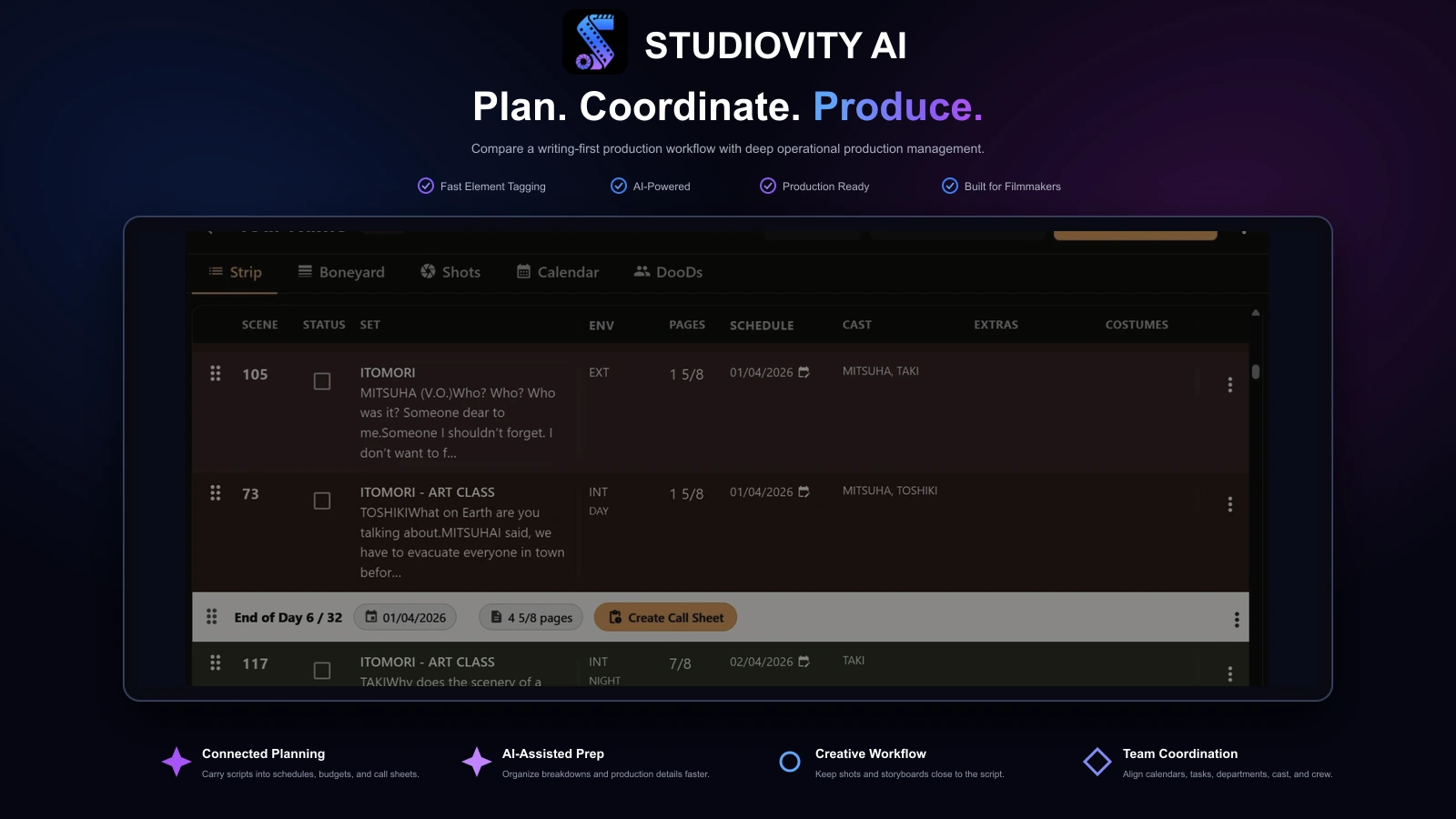
Choose Studiovity when your workflow starts with the story and needs to stay connected through the shoot. Its screenwriting, AI assistance, breakdowns, storyboards, shot lists, schedules, budgets, call sheets, calendars, and team tools make it a balanced choice for modern creative teams.
Choose Yamdu when your organization needs deeper operational infrastructure. Its official feature set includes department workflows, recruitment, time cards, sustainability, distribution, security controls, integrations, and enterprise options in addition to core pre-production tools.
This is not a comparison between a complete platform and a narrow one. Both are broad; the decision depends on whether creative continuity or operational depth matters more.
Why Studiovity
A direct path from idea to shoot day
Studiovity keeps the creative source of truth close to every planning decision, making it especially useful when writers, directors, producers, and crews share responsibility across the project.
Writing-first workflow
Develop screenplays with AI assistance, then carry current script context directly into production planning.
Creative planning together
Keep breakdowns, shot lists, storyboards, schedules, and call sheets close to the writing process.
Accessible production control
Give indie crews, agencies, schools, and production teams a broad toolkit without an enterprise-first setup.
Connected daily work
Coordinate calendars, tasks, budgets, departments, cast, crew, and shoot-day information in one project.
Work across devices
Review scripts, plans, schedules, and call sheets through web, desktop, tablet, iOS, and Android workflows.
Feature comparison
Studiovity and Yamdu compared
Both platforms provide substantial pre-production and production-management coverage. Their clearest differences appear in writing assistance, enterprise operations, integrations, and specialist administrative tools.
| Feature | Studiovity | Yamdu |
|---|---|---|
| Professional screenwriting | Included | Limited |
| AV script workspace | Included | Included |
| AI writing assistance | Included | Limited |
| AI-enhanced script breakdown | Included | Included |
| Shot lists and storyboards | Included | Included |
| Shooting schedules and DOODs | Included | Included |
| Production budgeting | Included | Included |
| Call sheets | Included | Included |
| Production calendars and tasks | Included | Included |
| Cast and crew management | Included | Included |
| Native iOS and Android access | Included | Included |
| Time cards and sustainability tools | Limited | Included |
| Enterprise API and advanced integrations | Limited | Included |
| Built-in teleprompter workflow | Included | Not available |
Features and plan access can change. Limited may indicate partial support, a different implementation, or availability on selected plans. Confirm current capabilities and pricing directly with each provider.
Core workflows
Where the platforms differ
Writing and script development
Studiovity is stronger before the script is locked.
Studiovity combines professional screenwriting with AI-assisted dialogue, tone, translation, error detection, structure, and AV scripts. Yamdu supports script import, AV scripts, Final Draft exchange, AI synopsis, one-liners, and script-change workflows, but its center of gravity is production management rather than long-form screenplay development.
Breakdown and creative departments
Both are capable; Yamdu adds deeper department-specific operations.
Both platforms use AI-assisted breakdown workflows and connect script information to production planning. Yamdu adds structured tools for locations, costume, makeup and hair, production design, company databases, and external contacts. Studiovity keeps breakdown especially close to writing, shots, storyboards, schedules, and call sheets.
Scheduling, budgeting, and call sheets
The core capabilities are closely matched.
Both support shooting schedules, day-out-of-days planning, budgeting, and call sheets. Yamdu emphasizes schedule imports, Dynamic Globals, reusable templates, tracking, and interoperability. Studiovity emphasizes a direct, connected flow from screenplay and breakdown into the practical shoot plan.
Collaboration and crew management
Studiovity favors approachable coordination; Yamdu favors operational depth.
Both centralize cast, crew, calendars, tasks, files, permissions, and production updates. Yamdu adds recruitment, time cards, distribution, sensitive-information controls, advanced tracking, and optional production-office features. Studiovity is a strong fit when a mixed creative and production team wants fewer layers between writing and execution.
Integrations and enterprise workflows
Yamdu has the advantage for formal production infrastructure.
Yamdu publishes integrations for Final Draft, Movie Magic, Showbiz Budgeting, calendars, Slack, Zapier, and other production tools, with API and MCP options on advanced plans. Studiovity is the better fit when the priority is replacing more separate tools with one cohesive workspace rather than connecting an existing enterprise stack.
Choose Studiovity
For creative-to-production continuity
- Your project begins with writing and must move smoothly into visual and logistical planning.
- AI writing, breakdown, storyboarding, scheduling, and production tools should live together.
- You run an indie production, agency, school, commercial team, or growing production company.
- You want broad capability with a more direct script-to-set workflow.
- A built-in teleprompter and cross-device creative workflow add practical value.
Choose Yamdu
For complex production operations
- You manage complex, multi-department media operations and formal approval processes.
- Time cards, recruitment, sustainability reporting, and travel management are priorities.
- Your workflow depends on Final Draft, Movie Magic, Showbiz, Slack, Zapier, or API integrations.
- Advanced security, tracking, SSO, white labeling, or enterprise data controls are required.
Pricing and scale
Compare team structure as well as price
Yamdu currently lists Flex for individuals and small teams, Studio for production companies, and custom Signature plans. Published plan details include per-user and project limits, storage, a shared core feature set, and optional enterprise capabilities.
Studiovity provides options for writers, productions, and education. Check both vendors directly before purchasing, then compare the total cost of users, projects, integrations, administration, and any separate creative tools your workflow still requires.
Best fit by team
Similar coverage, different centers of gravity
Independent and creative teams
Studiovity offers a more direct path across writing, AI-assisted development, visuals, planning, and shoot-day communication.
Production companies
Both deserve evaluation. Choose based on whether creative continuity or operational administration drives the daily workflow.
Enterprise operations
Yamdu has a clear case where advanced integrations, time cards, sustainability, security controls, and formal department processes are mandatory.
Q&A
Studiovity vs Yamdu questions
Is Studiovity better than Yamdu?+
Studiovity is often better for creators and production teams that want screenwriting, AI assistance, visual planning, and production management in one approachable script-to-set workflow. Yamdu may be better for larger operations needing deeper integrations, time cards, sustainability tools, and enterprise controls.
Does Yamdu support script breakdown and scheduling?+
Yes. Yamdu supports script import, AI-enhanced breakdown suggestions, shooting schedules, day-out-of-days reports, call sheets, budgeting, shot lists, storyboards, and production calendars.
Which platform is better for independent filmmakers?+
Studiovity is usually the more natural fit for independent filmmakers because writing, breakdowns, visuals, schedules, budgets, call sheets, tasks, and crew coordination remain in one connected creative workflow.
Which platform is better for large production companies?+
Yamdu deserves serious consideration for large organizations that need structured department workflows, integrations, time cards, sustainability tracking, advanced security, API access, and formal production-office processes.
Can both platforms manage cast and crew?+
Yes. Both support cast and crew management and shared production information. Yamdu adds recruitment, time cards, distribution, and sensitive-information controls, while Studiovity keeps team coordination closely connected to scripts and pre-production tools.
What is the main reason to choose Studiovity?+
Choose Studiovity when workflow continuity matters most: the same project can move from writing and AI-assisted development into breakdowns, shots, storyboards, schedules, budgets, call sheets, and production coordination.

Keep Your Story and Production Connected
Write, break down, visualize, schedule, budget, and coordinate your production in Studiovity.
Are you an Educator, Educational Institute, or Student?See special pricing →