2026 AI screenwriting guide
5 Best AI Screenwriting Tools in 2026
The right screenwriting AI should protect professional structure and the writer’s voice. Studiovity ranks first because it carries the story from initial idea through screenplay development and into production planning.
Decision framework
Which AI screenwriting tool should you choose?
Choose the tool that matches where your writing process usually breaks down. A lightweight AI script generator may be enough for first-draft momentum, but collaborative productions need formatting, review, revision control, breakdowns, visuals, and a practical handoff.
Studiovity is the most complete choice for writers who also produce, direct, or collaborate closely with a production team. FinalBit offers a broad AI filmmaking workflow, Celtx provides established cloud collaboration, Squibler accelerates drafting, and Sudowrite supports imaginative exploration.
The best screenwriting AI is not the one that produces the most text. It is the one that helps the writer make stronger decisions while preserving control over the script.
How the tools were ranked
What matters in AI screenplay software
Screenplay-aware AI
Does the tool understand scenes, action, dialogue, character intent, pacing, and controlled revision?
Professional formatting
Can writers preserve screenplay structure without fighting margins, headings, dialogue placement, or exports?
Story planning depth
Are beat boards, cards, outlines, character tools, and scene organization part of the workflow?
Collaboration and review
Can co-writers, producers, directors, and editors give feedback without losing version clarity?
Production readiness
Can the script become breakdowns, shots, boards, schedules, budgets, or call sheets?
Creative control
Does AI offer useful options while leaving voice, meaning, and final decisions with the writer?
The ranked top five
The best AI screenwriting tools in 2026
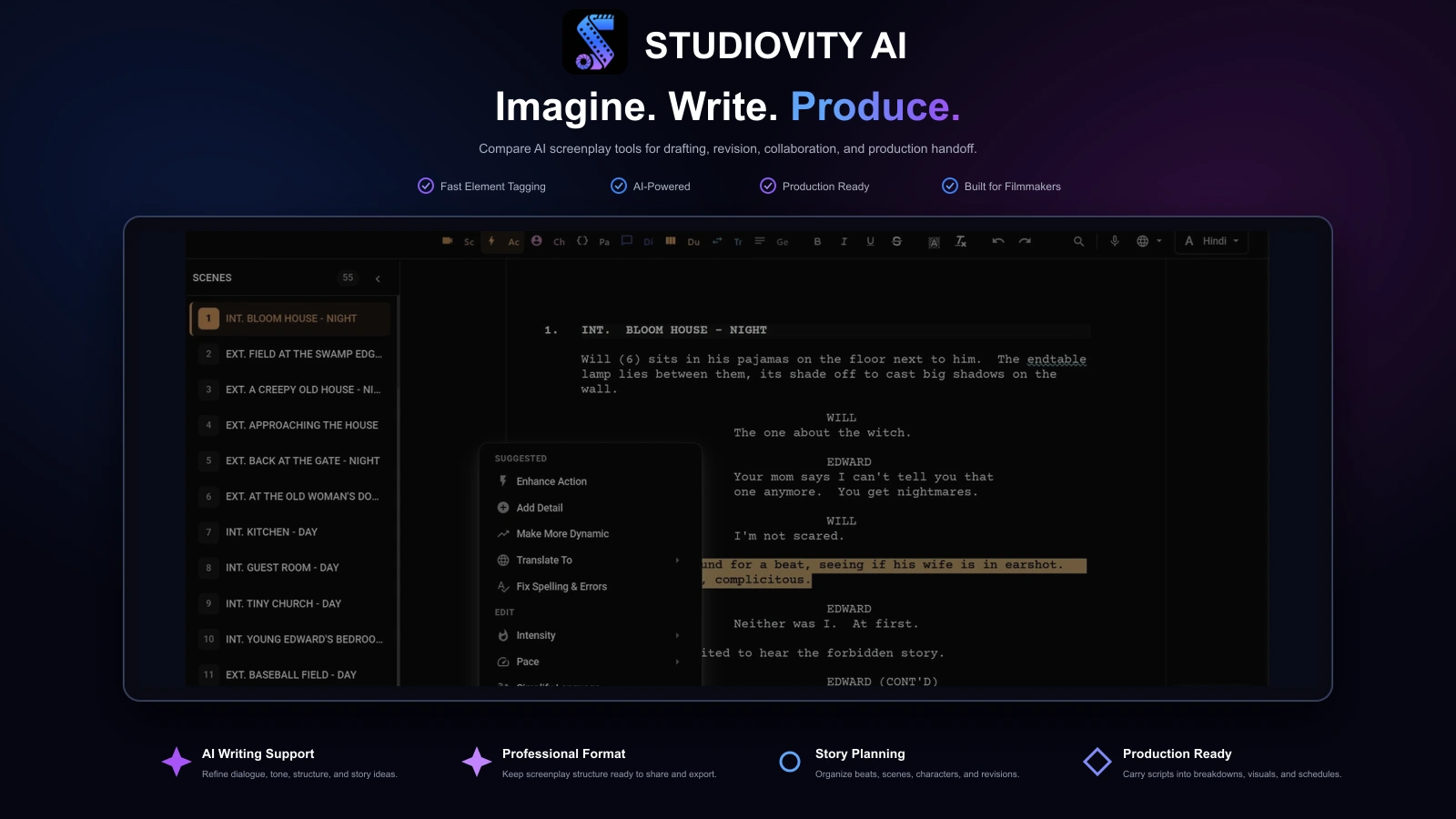
Studiovity combines AI-assisted screenplay writing with dialogue refinement, tone adjustments, translation, error detection, beat boards, index cards, AV scripts, professional formatting, and import or export tools.
It ranks first because the script can continue into breakdowns, storyboards, shot lists, schedules, budgets, call sheets, calendars, and team management without rebuilding the project elsewhere.
FinalBit, formerly NolanAI, combines AI screenwriting and script coverage with automatic breakdowns, storyboards, shot lists, budgeting, scheduling, and pitch-oriented tools.
It is a serious end-to-end competitor. Studiovity remains the stronger recommendation when a script-first writing environment and day-to-day production coordination are the priority.
Celtx offers multi-format script editors, beat sheets, storyboards, shot lists, breakdowns, schedules, call sheets, revisions, budgets, comments, and collaborative project history.
It remains dependable for writing partners, classrooms, and teams already familiar with its ecosystem, though AI writing is less central to its positioning than Studiovity’s connected workflow.
Squibler emphasizes concept prompts, generated screenplay drafts, scene and act management, character and story elements, collaboration, screenplay formatting, and PDF or Word export.
It is approachable for first-draft momentum and beginners, but productions moving toward a shoot will need additional tools for detailed breakdowns, visuals, schedules, budgets, and call sheets.
Sudowrite is a fiction-focused AI writing partner for exploring premises, character choices, descriptions, emotional tones, and alternative scene directions.
It can support early screenplay development beside a dedicated editor, but it is less complete for screenplay formatting, revisions, collaboration, and production handoff.
Feature comparison
AI screenwriting tools compared
Compare screenplay-specific writing support separately from broader filmmaking and production capabilities.
| Feature | Studiovity | FinalBit | Celtx | Squibler | Sudowrite |
|---|---|---|---|---|---|
| Professional screenplay formatting | Included | Included | Included | Included | Limited |
| AI drafting and rewriting | Included | Included | Limited | Included | Included |
| Dialogue, tone, and translation tools | Included | Limited | Limited | Limited | Limited |
| Beat, outline, and scene planning | Included | Included | Included | Included | Included |
| Writing collaboration | Included | Limited | Included | Included | Limited |
| Professional script import and export | Included | Included | Included | Limited | Limited |
| AV script workflow | Included | Limited | Limited | Not available | Not available |
| Script breakdown | Included | Included | Included | Not available | Not available |
| Shot lists and storyboards | Included | Included | Included | Not available | Not available |
| Scheduling, budgeting, and call sheets | Included | Included | Included | Not available | Not available |
Features and plan access change frequently. Limited may indicate partial support, a general-purpose workflow, or availability on selected plans. Verify current capabilities and export formats with each provider.
Why Studiovity leads
The screenplay becomes a production plan
A scene can begin as an idea, move through AI-assisted revision and structural planning, then become breakdown elements, storyboard frames, shots, schedule requirements, budget decisions, and call-sheet information.
That continuity matters because a film does not end at “Fade Out.” Props, locations, cast, departments, and collaborators all depend on the current script. Studiovity keeps those stages inside one shared project.
Buying checklist
Choose a tool that matches your next step
Avoid paying for software that solves the wrong problem. Test one real scene, revision cycle, and handoff before committing a full project.
Full workflow support
Start with Studiovity when the screenplay must continue into visual planning and production.
Coverage and pitch assets
Compare FinalBit when AI script feedback and pitch-oriented filmmaking tools are central.
Established cloud collaboration
Consider Celtx when collaborators already know and prefer its online ecosystem.
Fast first-draft momentum
Test Squibler when generating and organizing initial screenplay pages is the main obstacle.
Imaginative brainstorming
Use Sudowrite to explore voice, character, premise, and scene possibilities before formatting.
Professional delivery
Confirm script formats, revisions, comments, permissions, and production handoff before committing.
Q&A
Choosing an AI screenwriting tool
Why is Studiovity ranked as the best overall choice?+
Studiovity combines AI-assisted screenwriting with professional structure, beat planning, index cards, AV scripts, collaboration, breakdowns, visual planning, schedules, budgets, call sheets, calendars, and team management. That makes it useful beyond the draft.
Is Studiovity only for professional studios?+
No. Solo writers, indie filmmakers, commercial creators, students, and production teams can all use it. The connected workflow becomes increasingly valuable as more collaborators join a project.
When should I choose a competitor instead?+
Choose Squibler for fast AI drafting, Sudowrite for fiction-style ideation, Celtx for a familiar collaboration ecosystem, or FinalBit when AI coverage and pitch-oriented filmmaking tools are central. Choose Studiovity for the strongest writing-to-production continuity.
Does AI replace the screenwriter?+
No. AI can provide options, organization, and revision support, but the writer remains responsible for voice, meaning, character intention, taste, and the final screenplay.

Write the Script and Build the Production
Develop, refine, break down, visualize, schedule, and coordinate your story in Studiovity.
Are you an Educator, Educational Institute, or Student?See special pricing →